Suicide and Choosing to Keep Living
East of the MountainsSuicide and Choosing to Keep Living is the late-stage moral and emotional reversal in Ben Givens’s story: he begins to relinquish a plan for self-destruction when he can no longer sustain the belief that dying would spare his family, and when concrete ties to others give him reasons to return. The change is not presented as a simple cure for grief or fear. It emerges through speaking, being answered, and remembering obligations and promises that suicide would end.
The Burden He Meant to Spare His Family
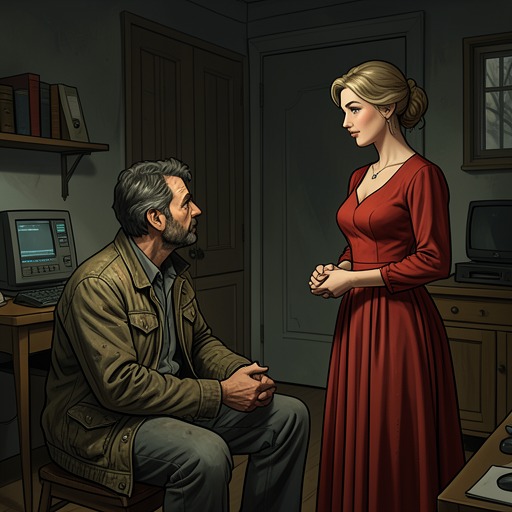
Ben’s conversation with Bea Harden gives his crisis a listener outside his family. Asked about his blackened eye, he starts with Rachel Givens’s death, then tells of his daughter and grandson and the chain of events that has brought him to this point. He does not recount every detail, but he tells the story in order: his shotgun is lost, his dog is wounded, his eye is injured, and he has become transient. The act of telling feels good to him. Its linear shape makes a difficult, scattered passage into an account he can share, while Bea’s status as a stranger makes her, for that moment, the person to whom he can speak.
Bea identifies the plan plainly as suicide and says she could not imagine it. Ben’s explanation is less about wanting to punish or abandon his family than about believing his illness would impose suffering on them. As they pass fields and orchards, he presses experimentally on his eyelid and says he did not want to burden his family or put them through nine months of watching him die. In his reckoning, absence would protect them from the pain of his decline.
Bea firmly rejects that calculation. She tells him that his dying would not be a burden and asks him to consider what his family could learn from it: seeing him die, she argues, could make them more compassionate. Her answer does not deny that his family would suffer; it contests the meaning Ben has assigned to that suffering. The care he understands as sparing them would also deprive them of the chance to accompany him, and of whatever understanding his death might leave them. The exchange shifts the question from whether his illness will hurt his family to whether his presence through that pain might matter.
The Failed Attempt and the Reasons to Return
As the road reached the bend above the Columbia River, Bea asked what had changed Ben’s mind. He answered first with a word that minimized the decision: cowardice. Trying to shoot himself, he said, was not easy. Bea suggested sleeping pills, but Ben said he could not do it. Her response cut through his explanation: “You didn't really want to.” Ben only shrugged. The exchange leaves the precise balance of fear, reluctance, and desire unstated, but makes clear that the failed attempt cannot by itself explain his return. Bea proposes another account, reminding him that he saved a baby the night before. His choice to help someone else becomes evidence against the belief that he had wholly surrendered his connection to life.
The landscape around their conversation gives the turn a quiet, outward scale: ducks pass above them, geese gather on the river near Wanapum Dam, and the wind moves north through the canyon. After they cross the river, Ben recalls a promise he and Rachel Givens made when they married: they would have their ashes buried together. Bea calls the idea romantic; Ben says they had felt that way, and that he likes it too. The promise gives his survival a future-shaped meaning tied not to recovery from grief, but to a bond with his dead wife that he still intends to honor.
Ben then names the consequence he had not fully reckoned with: if he had gone through with shooting himself, their shared burial might never happen. Bea answers that coyotes and worms would claim him instead. Ben accepts this as another reason he is going home. The decision is therefore neither a triumphant cure nor a denial of mortality. He remains ill and bereaved, but his imagined ending has changed: rather than choose an isolated death that would break the promise, he turns toward home and the possibility of keeping it.
The Return Made Concrete
The decision to go home becomes tangible when Ben and Bea collect Rex from the clinic in Quincy, Washington. Ilse Peterson is occupied, so a woman at reception promises to pass along Ben’s gratitude and brings out the dog. Ben checks Rex’s staples, strokes his coat, and lays him on a blanket across the backseat. He whispers, “We're going home.” The words turn a decision about the future into an immediate act of care: Ben is responsible for bringing his wounded companion back, not simply for ending his own journey.
On the drive toward George, Washington, the irrigated fields make the landscape’s apparent fertility seem precarious. Ben sees the cultivated land meeting the desert in abrupt lines; beyond them, the sage has been pulled up by the roots, and the plateau remains arid beneath the crops. The fields depend on water that may not always arrive. This fragile abundance offers no promise that suffering will disappear, but it sharpens the distinction between an imposed ending and a return to life as it is: vulnerable, unfinished, and still connected to others.
The journey continues over Ryegrass Summit and through the Quilomene into the Kittitas Valley, where the trees along Manastash Ridge have turned russet and yellow. Bea remarks that October is beautiful on this side of the mountains. After the argument about suicide, the shared burial promise, and the decision to return, the changing season gives the homeward passage a measured close. Ben’s choice is registered not as a declaration that death has ceased to matter, but as movement through a world whose companions, obligations, and seasons remain present.
A Choice That Remains Open
Ben’s return does not settle the meaning of survival into a single explanation. He calls his failed attempt cowardice, while Bea understands his actions differently: the baby he saved testifies to a capacity for care that his account of himself as ready to die cannot erase. Neither interpretation wholly replaces the other. Instead, the conversation leaves Ben’s change of mind grounded in relationships and acts that extend beyond private fear—the family he had hoped to spare, the promise he made with Rachel, and the wounded companion he is taking home. The decision matters precisely because it does not abolish illness or grief; it alters what Ben will do while living with them. The passage thus treats choosing to live not as a declaration of restored certainty, but as a renewed acceptance of attachment, responsibility, and an unfinished future.